Comparing Web Solutions: Cloud Hosting versus VPS for Business
Discover the distinctions between cloud infrastructure and virtual private servers. Evaluate performance capabilities, expansion potential, and financial considerations to identify the ideal solution for your company requirements.
Final Assessment
With nearly 90% of web users unlikely to revisit following a negative website experience, choosing appropriate hosting infrastructure is essential for commercial success. Cloud infrastructure and virtual private servers represent prominent solutions, each offering distinctive advantages tailored to varied requirements. This examination explores both options comprehensively, providing comparative insights to help determine which approach best corresponds with your organizational objectives and technical specifications.
Understanding Cloud Infrastructure
This segment provides comprehensive information about cloud infrastructure. You’ll discover its definition, principal characteristics, and major advantages and disadvantages of this widely-adopted hosting approach.
Cloud Infrastructure: Fundamentals and Essential Characteristics
Cloud infrastructure involves operating applications or websites on virtualized servers within a distributed environment. Resources can be allocated across multiple machines using virtualization technology, establishing a highly adaptable hosting framework. This enables websites and applications to operate on interconnected server networks that function collaboratively, ensuring continuous availability and enhanced performance.
The principal benefit of cloud infrastructure is the capability to dynamically adjust resources including processing power, memory, and storage capacity as required. This adaptability makes it particularly suitable for managing unexpected workload increases and maintaining smooth operation of websites and applications.
In cloud environments, resources supporting each website are duplicated across all servers in the network, ensuring continuous website accessibility. Requests for specific sites automatically redirect to alternative servers within the network when individual machines experience heavy traffic. This distribution of resources across network servers enhances reliability.
Consequently, even during individual machine failures, hosting services maintain uninterrupted operation and high-quality performance. According to Market.us research, combined market value for hybrid, private, and public cloud computing is estimated at $633 billion for 2023, projected to reach $2,321 billion by 2032.
Cloud Infrastructure: Advantages and Limitations
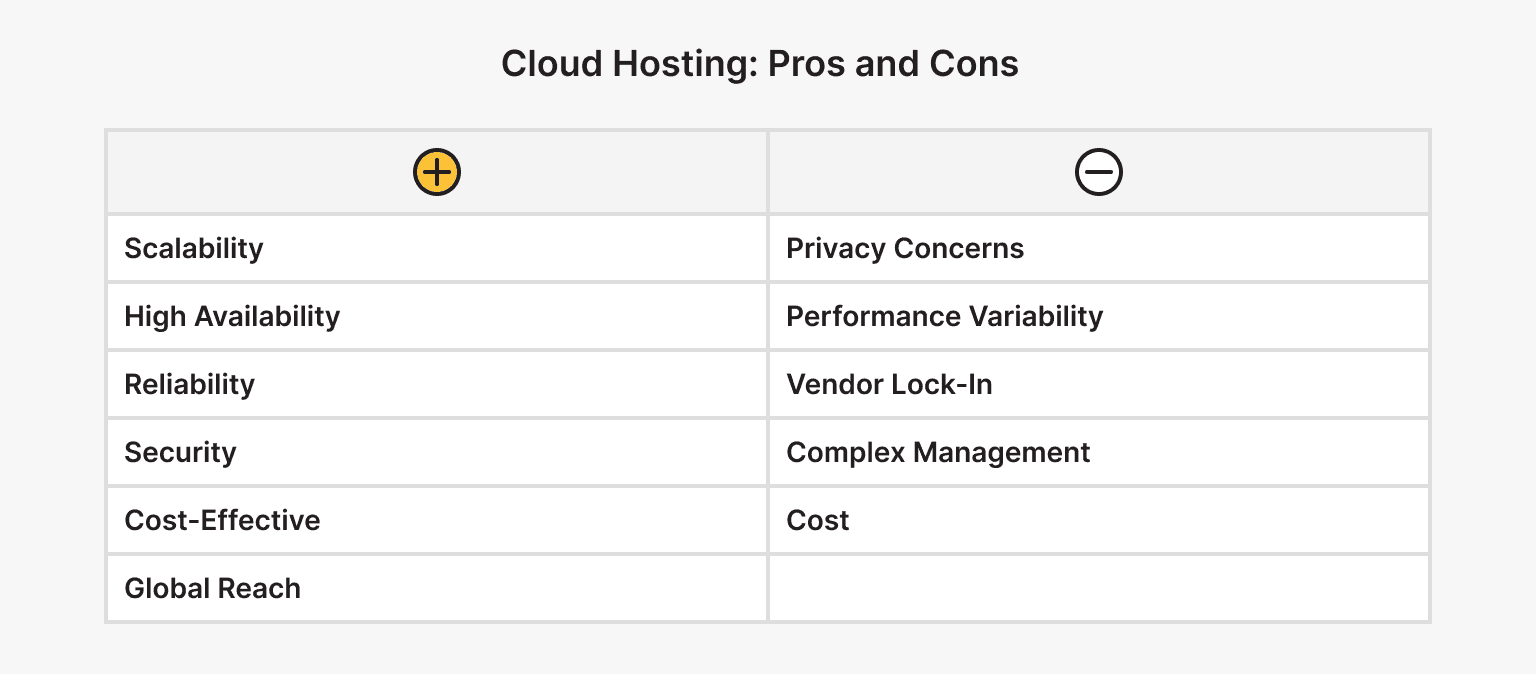
Based on key characteristics of cloud infrastructure, certain benefits and drawbacks become apparent.
This section outlines principal advantages and disadvantages of cloud infrastructure.
Benefits of Cloud Infrastructure:
• Expandability. Cloud infrastructure permits effortless resource adjustment to accommodate traffic fluctuations or growth without manual intervention. It avoids the constraints of individual servers. Resources become available instantly according to demand.
• Continuous Operation. Cloud infrastructure typically includes redundancy and failover capabilities, ensuring backup systems and extended operational periods.
• Dependability. Websites operate on virtual segments utilizing multiple physical networks, creating highly reliable systems. Server malfunctions slightly reduce available cloud resources without compromising site functionality.
• Protection. Many cloud providers implement protection measures including data encryption, protective barriers, and sophisticated monitoring. Multiple physical servers safeguard information against unauthorized access or service disruptions.
• Economic Efficiency. Cloud infrastructure enables businesses to minimize expenses by implementing consumption-based payment models.
• Worldwide Distribution. Cloud infrastructure facilitates global content delivery, decreasing response delays and enhancing performance for international users.
Limitations of Cloud Infrastructure:
• Confidentiality Issues. Despite robust security measures, storing sensitive information on external systems raises concerns regarding privacy and data exposure.
• Inconsistent Performance. Infrastructure load across cloud providers can affect resource availability, potentially causing decreased operational efficiency.
• Provider Dependency. Platform differences can complicate migration of information and applications between cloud providers.
• Management Complexity. Configuring and optimizing cloud infrastructure presents challenges, particularly for organizations without dedicated technical departments.
• Expenses. Cloud infrastructure costs may increase over time, especially when utilizing premium features or continuously expanding resources.
Summary:
Following detailed examination of cloud infrastructure, its key features, advantages, and limitations, it emerges as an expandable, dependable, and adaptable solution suitable for organizations of various sizes. However, careful evaluation of trade-offs remains important when selecting hosting solutions, particularly regarding security considerations, expense management, and performance requirements.
Global Presence
Multinational infrastructure utilizing exceptionally reliable equipment in premier data facilities.
COVERAGE Details
Understanding VPS Solutions
This segment provides information about VPS solutions, including principal characteristics, advantages, and limitations.
Virtual Private Servers: Fundamentals and Essential Characteristics
VPS solutions, or Virtual Private Server Solutions, represent a hosting approach that employs virtualization technology to provide dedicated resources within shared physical servers. Physical machines are partitioned into multiple virtual servers, each operating independent systems and hosting environments. Each virtual server accesses specific machine resources, offering enhanced control and customization compared to shared hosting options.
The primary disadvantage of VPS solutions involves vulnerability to issues affecting specific resource allocations. In such scenarios, websites on affected allocations may become temporarily inaccessible pending resolution and backup restoration. Serious problems affecting specific allocations, such as distributed service disruption attacks, could potentially cause complete system failure since all resources reside on single machines.
However, the principal advantage of VPS solutions is the provision of isolated environments with dedicated processing, memory, and storage capacities. This grants users enhanced control and customization possibilities compared to shared hosting arrangements. VPS solutions often represent intermediate options between shared hosting and dedicated servers, combining affordability with improved performance.
VPS Solutions: Advantages and Limitations
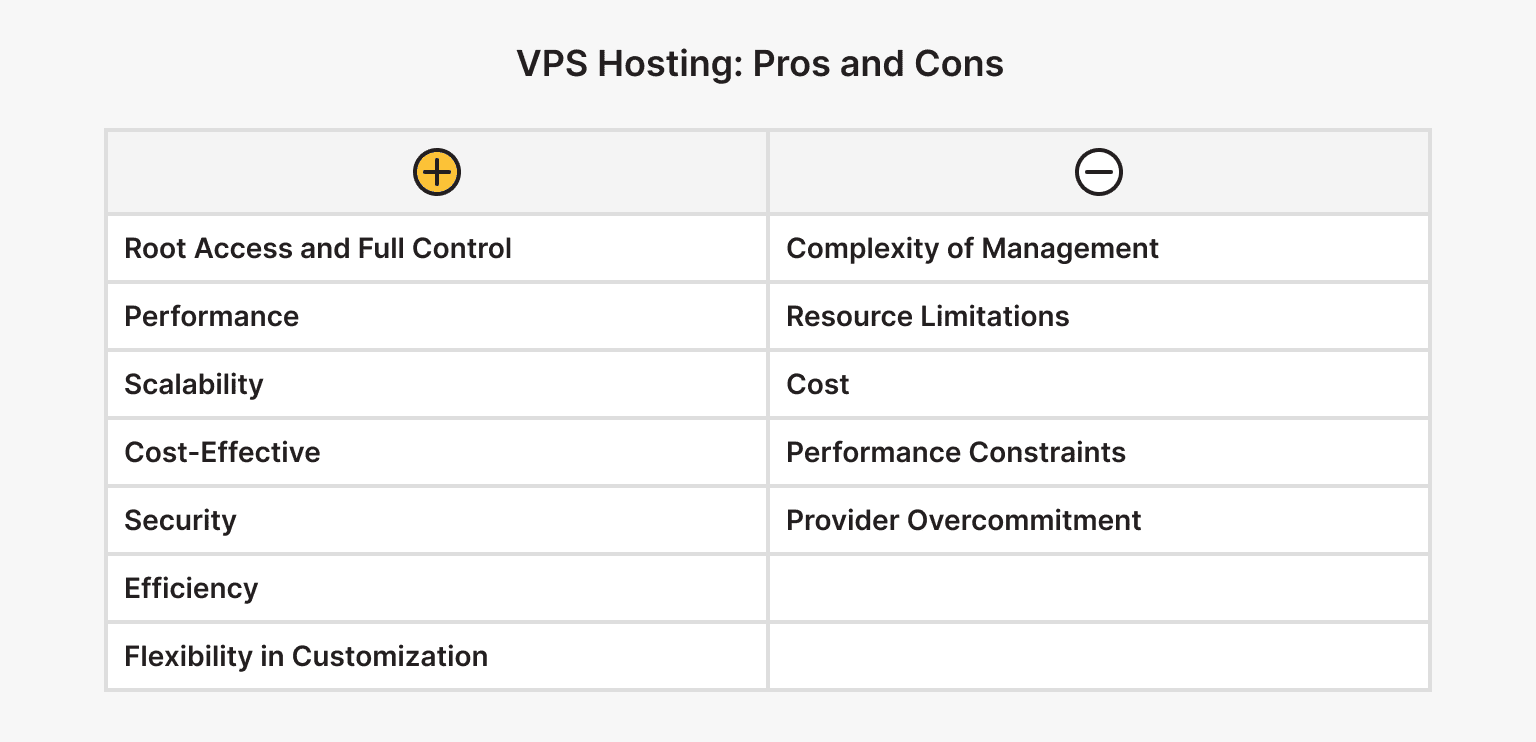
Considering the principal characteristics of VPS solutions, key advantages and disadvantages become evident.
This section outlines primary benefits and drawbacks of VPS solutions.
Benefits of VPS Solutions:
• Administrative Access and Complete Control. VPS solutions permit installation of custom applications, environment configuration, and comprehensive server management according to specific requirements.
• Operational Efficiency. VPS provides superior capabilities compared to shared hosting because resources are specifically allocated to individual virtual servers, minimizing resource conflicts.
• Expansion Capability. As websites or applications grow, VPS solutions facilitate straightforward increases in processing power, memory, and storage without requiring migration to different servers.
• Cost Effectiveness. VPS solutions cost less than dedicated hosting while offering comparable control and performance benefits.
• Enhanced Protection. VPS solutions offer improved security compared to shared hosting through isolation of server environments from other users on shared physical machines.
• Operational Efficiency. Unlike shared hosting, VPS ensures operational performance remains unaffected by traffic or usage patterns of other customers. Each virtual server functions independently.
• Customization Flexibility. VPS solutions support various software configurations and operating environments, providing flexibility for different application types.
Limitations of VPS Solutions:
• Administrative Complexity. VPS solutions require users to manage and maintain their servers, including software installation and security updates. While this control benefits users, it necessitates specific technical expertise.
• Resource Constraints. Although VPS solutions provide dedicated resources, these resources remain distributed across shared physical machines among multiple virtual servers. Overloaded physical servers may experience performance degradation.
• Financial Considerations. VPS solutions exceed shared hosting costs, making them less appropriate for small websites or businesses with limited financial resources.
• Performance Limitations. While VPS provides enhanced resources compared to shared hosting, it may not match the performance and flexibility of dedicated server options.
• Provider Overcommitment. Although performance represents a VPS advantage, negative impacts can occur if hosting providers overcommit infrastructure by allocating more resources than hardware supports.
Summary:
Following examination of VPS solutions, their key features, advantages, and limitations, we can conclude: VPS solutions represent excellent options for businesses and developers seeking enhanced control, performance, and scalability. However, they require advanced technical expertise and best suit growing websites or applications requiring dedicated resources.
VPS for Your Initiative
Optimize your budget with our high-performance VPS solutions. Benefit from rapid NVMe technology, global presence across 35+ countries, and additional advantages.
PACKAGES
Cloud Infrastructure vs. VPS: Analysis and Fundamental Differences
This section includes a comparative summary table analyzing cloud infrastructure and VPS solutions. It highlights key differences between these hosting approaches based on these characteristics:
• Expansion capability
• Performance efficiency
• Cost structure
• Flexibility
• Reliability
• Security measures
• Customer assistance
Here’s the table reformatted in your desired style:
Characteristic | Cloud Infrastructure | VPS Solutions |
Expansion | Highly expandable, enabling on-demand resource adjustment | Limited expansion, but supports resource addition or server upgrade |
Performance | Effective performance with resources distributed across servers | Performance depends on individual server hardware |
Cost Structure | Higher expenses due to consumption-based billing approach | More economical with fixed monthly fees for dedicated resources |
Flexibility | Highly adaptable with simple scaling and diverse service options | Limited adaptability but greater resource control |
Reliability | Highly dependable with multiple servers and automatic failover | Varies by provider; generally reliable with optional redundancy |
Security Measures | Protected through multiple layers including firewalls/encryption | May require additional security implementations |
Customer Support | Round-the-clock assistance and maintenance, provider-dependent | Round-the-clock assistance and maintenance, provider-dependent |
Professional web hosting provider is*hosting delivers reliable dedicated and virtual private servers, outstanding customer assistance, and persistent quality assurance.
Cloud Infrastructure vs. VPS Solutions: Implementation Scenarios
The table below outlines ideal implementation scenarios for cloud infrastructure and VPS solutions, based on their key features and respective advantages and limitations.
Cloud Infrastructure Ideal Scenarios | VPS Solutions Ideal Scenarios |
Websites or applications with fluctuating traffic | Small to medium-sized websites or enterprises |
High-traffic websites requiring expansion capabilities | E-commerce or small online retail operations |
Startups needing economical, consumption-based resources | Applications with stable resource requirements |
Applications requiring continuous availability/disaster recovery | Users needing enhanced server environment control |
Enterprises requiring global reach with minimal response delays | Budget-conscious projects requiring dedicated resources |
Applications benefiting from dynamic scaling | Users prioritizing fixed, predictable expenses |
Summarizing the proposed implementation scenarios for cloud infrastructure and VPS solutions:
• VPS Solutions suit companies with consistent and predictable resource requirements, those seeking reduced expenses, and those requiring enhanced control over server environments.
• Cloud Infrastructure provides superior availability, expansion capability, and flexibility, making it appropriate for businesses with consistent workloads or increasing traffic demands. However, this hosting option may incur higher long-term expenses, necessitating proper resource management to avoid unnecessary costs.
Combined Approaches: Integrated Hosting Frameworks
When choosing between hosting solutions proves challenging, combined approaches may represent optimal choices. Integrated hosting frameworks combine the advantages of cloud and VPS solutions, offering adaptable, expandable, and economical infrastructure for businesses with diverse requirements. Integrated hosting enables companies to optimize performance and manage workloads efficiently by utilizing dedicated VPS resources alongside the adaptability and expansion capabilities of cloud environments.
Cloud-VPS Integration: Advantages and Obstacles
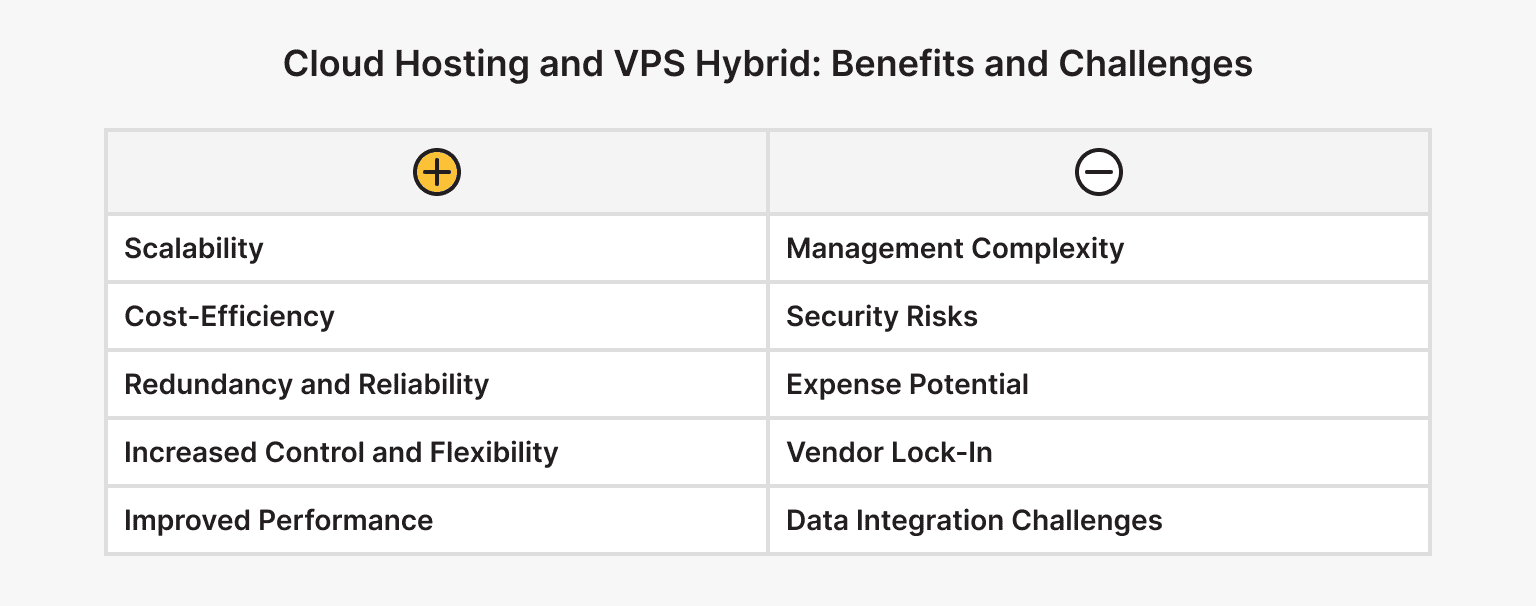
Integrated hosting frameworks combine the benefits of cloud infrastructure and VPS solutions, presenting both advantages and challenges. The following sections outline principal benefits of integrated hosting frameworks and potential challenges of this combination.
Benefits of Integrated Hosting Frameworks
Expansion Capability
Integrated hosting allows businesses to rapidly increase resources. When additional capacity becomes necessary, cloud infrastructure can supplement existing systems to ensure traffic peaks or growing demands remain accommodated without performance degradation. Cloud adaptability complements fixed VPS resources, providing on-demand expansion.
Economic Efficiency
Businesses benefit from the fixed recurring costs of VPS solutions while paying only for utilized cloud resources. This makes integrated hosting economical for companies with seasonal or intermittent requirements. Resource optimization occurs through dynamic allocation according to needs, combining VPS reliability with cloud adaptability.
Redundancy and Reliability
Integrated hosting frameworks enhance reliability by distributing workloads across cloud and VPS resources. If one platform (such as VPS) experiences failure, workloads can quickly transition to cloud environments, ensuring uninterrupted service with minimal downtime.
Cloud infrastructure redundancy further ensures availability of critical databases and applications, even during peak traffic periods or hardware malfunctions.
Enhanced Control and Flexibility
Businesses utilizing integrated hosting enjoy combined benefits: the customization and management control of VPS solutions with the expansion capability and adaptability of cloud environments.
This enables businesses to adjust hosting environments according to specific workload requirements, enhancing operational productivity.
Improved Performance
Businesses can utilize VPS for stable, long-term applications while employing cloud resources for expandable, scalable capabilities. Cloud resources accommodate peak demand periods, while VPS handles routine operations.
This platform combination ensures seamless user experiences.
Managed VPS
Optimize your budget and business efforts with our managed VPS. Benefit from rapid NVMe technology, dedicated support, and comprehensive administration.
PACKAGES
Challenges of Integrated Hosting Frameworks
Management Complexity
Managing integrated hosting environments presents greater challenges than single-platform management. Integration requires coordinating VPS and cloud resources, establishing load distribution, data synchronization, and monitoring systems.
Businesses must develop expertise in managing both cloud and VPS systems, including addressing security concerns and compatibility issues.
Security Considerations
Integrated infrastructure presents security challenges, particularly regarding data movement between cloud and VPS environments. Managing secure data transfers, implementing encryption, and enforcing consistent security policies across platforms increases complexity.
Properly securing cloud resources and VPS requires careful planning and implementation.
Potential Expenses
While integrated hosting proves economical when properly managed, misused cloud resources or inefficient workload distribution between cloud and VPS environments can create unnecessary expenses.
With cloud services operating on consumption-based models, companies must carefully monitor resource usage and allocation to maintain budget constraints.
Provider Dependency
Integrated hosting often involves multiple provider relationships, potentially creating dependency issues. Excessive reliance on specific cloud or VPS providers may restrict flexibility and complicate provider transitions.
Data Integration Challenges
Transferring information between cloud and VPS platforms presents challenges, particularly when different platforms or technologies are involved. Reliable data synchronization tools and methodologies become essential for ensuring seamless platform integration and consistency. Without proper management, issues including response delays, data consistency, and synchronization between VPS and cloud services can disrupt operations.
In summary, integrated hosting frameworks offer businesses the flexibility of VPS solutions combined with cloud expansion capabilities, providing ideal infrastructure for organizations with dynamic workloads or changing requirements. While integrated infrastructure offers numerous benefits including expansion capability, economic efficiency, and improved performance, management complexity, security considerations, and potential provider dependency present challenges. Businesses should carefully evaluate these factors when considering integrated hosting solutions to ensure alignment with organizational needs and resources.
Final Assessment
In conclusion, both cloud infrastructure and VPS solutions provide flexible and expandable options, differing primarily in management approaches and infrastructure design. When selecting hosting solutions, careful consideration of specific business requirements remains essential. For continuous availability and automatic expansion capability, cloud infrastructure represents the superior choice, while VPS solutions offer enhanced control and economical approaches for growing websites. When selection between options proves challenging, integrated hosting frameworks can provide balanced benefits. However, understanding and addressing potential challenges of combining these platforms remains crucial. We hope this article has enhanced your understanding of key features for each hosting solution and serves as a valuable reference for selecting the most appropriate option for your business.